Brook's law states that adding manpower to a late project makes it later.
The increased communication and management overhead of the new staff slows down the incumbent project members.
I'm beginning to think this law extends before t=0 and into the recruitment process, too!
Tuesday, 1 March 2011

Sunday, 27 February 2011
Clean Code is Just Better
One thing that I've found time and time again in my coding career is that leads to a virtuous cycle of improvements. It's easier to read. It's easier to understand. It's easier to change. It's shorter. It simpler. It often even runs a fair bit faster. Expressing an idea in code more cleanly and clearly to both human readers and the compiler reaps many benefits.
Now, all this is frankly stating the bleeding obvious. Although, in this case, it had an interesting outcome: Cleaning up my Haskell raytracer code and fixing all the -Wall errors more than doubled its performance. It's now down from 3.5 minutes to 1.5 minutes.
Now, fixing up a few warnings in a lower-level language like C++ typically provides small execution time benefits or prevents future portability or correctness problems. But it just shows what a dramatic effect fixing warnings has in a higher level language. In such a language, a confused compiler can end up doing some very expensive things. From a performance perspective, you're not just blowing off your own foot, you're nuking the whole town.
Most of the issues I fixed were simple things like incomplete pattern matches, mixtures of ^ and ** and confusion over what return type to use for calls to things like round or truncate.
So, 90 seconds to raytrace a simple scene still isn't going to set SIGGRAPH alight, but it's beginning to get into the right sort of ballpark. This kind of win has provided evidence for my suspicion that the code was basically reasonable but something bad was going on under the hood. Just looking an the intermediate .hc files, I can see there is still a lot more time to be won back..
Now, all this is frankly stating the bleeding obvious. Although, in this case, it had an interesting outcome: Cleaning up my Haskell raytracer code and fixing all the -Wall errors more than doubled its performance. It's now down from 3.5 minutes to 1.5 minutes.
Now, fixing up a few warnings in a lower-level language like C++ typically provides small execution time benefits or prevents future portability or correctness problems. But it just shows what a dramatic effect fixing warnings has in a higher level language. In such a language, a confused compiler can end up doing some very expensive things. From a performance perspective, you're not just blowing off your own foot, you're nuking the whole town.
Most of the issues I fixed were simple things like incomplete pattern matches, mixtures of ^ and ** and confusion over what return type to use for calls to things like round or truncate.
So, 90 seconds to raytrace a simple scene still isn't going to set SIGGRAPH alight, but it's beginning to get into the right sort of ballpark. This kind of win has provided evidence for my suspicion that the code was basically reasonable but something bad was going on under the hood. Just looking an the intermediate .hc files, I can see there is still a lot more time to be won back..
Few more optimisations
Well, I've managed to knock off a further half minute from the execution time. The execution time now stands at 3.5 minutes down from just over 4.
I've achieved this with two main methods: strictness, and rewriting loops to be tail recursive.
By default, Haskell is a lazy language. Haskell defers evaluation of an expression until it is needed by creating a thunk. Whilst thunks may save work, thunks are not free. Thunks are an example of a work-saving technique that do not provide a net benefit for very small pieces of work or data.
Thunks can be eliminated by marking expressions as strictly evaluated. This technique forces an expression to be evaluated when it is encountered, rather than deferred. The Haskell compiler automatically treats some expressions as strict, but a programmer can force an expression to be strict using the BangPatterns language extension. You simply prefix the variables that you wish to be strictly evaluated using a pling (!).
I went through and marked up all of the trivial expressions and fields in the raytracer code. Things like the xyzw fields of a vector, rgba fields of a colour, field-of-views, radii, that sort of thing. Eliminating those thunks provided around half of the total savings.
More information on strictness here: http://www.haskell.org/haskellwiki/Performance/Strictness
Ensuring that loops were properly tail recursive provided the second half of the savings. Haskell does not provide traditional for() loops to iterate over arrays and lists; instead, recursion must be used. This may introduce extra space and time overhead due to the state accumulated at each function call.
Tail recursive functions eliminate this overhead as they allow the compiler to use the equivalent of a goto rather than a function call to traverse the next item of a list. This essentially converts the Haskell code into something resembling a traditional for loop.
More information here:
http://www.haskell.org/haskellwiki/Tail_recursion
http://book.realworldhaskell.org/read/profiling-and-optimization.html
I applied this optimisation to the light accumulation, object intersection and ray tracing loops. I also taken the opportunity to add a few simple optimisations to the main object intersection loop.
So, all in all, a few modest gains. What's becoming very apparent is that to seriously optimise Haskell code I need to learn Core. Core is Haskell's intermediate compilation language. 3.5 minutes is still a long time to ray-trace a very simple scene and I'm sure there must be a lot of win left in there. I could brute-force it in other languages in far less! Hopefully the Core will show some major overhead in the low level vector, colour, lighting and intersection code.
I've achieved this with two main methods: strictness, and rewriting loops to be tail recursive.
By default, Haskell is a lazy language. Haskell defers evaluation of an expression until it is needed by creating a thunk. Whilst thunks may save work, thunks are not free. Thunks are an example of a work-saving technique that do not provide a net benefit for very small pieces of work or data.
Thunks can be eliminated by marking expressions as strictly evaluated. This technique forces an expression to be evaluated when it is encountered, rather than deferred. The Haskell compiler automatically treats some expressions as strict, but a programmer can force an expression to be strict using the BangPatterns language extension. You simply prefix the variables that you wish to be strictly evaluated using a pling (!).
I went through and marked up all of the trivial expressions and fields in the raytracer code. Things like the xyzw fields of a vector, rgba fields of a colour, field-of-views, radii, that sort of thing. Eliminating those thunks provided around half of the total savings.
More information on strictness here: http://www.haskell.org/haskellwiki/Performance/Strictness
Ensuring that loops were properly tail recursive provided the second half of the savings. Haskell does not provide traditional for() loops to iterate over arrays and lists; instead, recursion must be used. This may introduce extra space and time overhead due to the state accumulated at each function call.
Tail recursive functions eliminate this overhead as they allow the compiler to use the equivalent of a goto rather than a function call to traverse the next item of a list. This essentially converts the Haskell code into something resembling a traditional for loop.
More information here:
http://www.haskell.org/haskellwiki/Tail_recursion
http://book.realworldhaskell.org/read/profiling-and-optimization.html
I applied this optimisation to the light accumulation, object intersection and ray tracing loops. I also taken the opportunity to add a few simple optimisations to the main object intersection loop.
So, all in all, a few modest gains. What's becoming very apparent is that to seriously optimise Haskell code I need to learn Core. Core is Haskell's intermediate compilation language. 3.5 minutes is still a long time to ray-trace a very simple scene and I'm sure there must be a lot of win left in there. I could brute-force it in other languages in far less! Hopefully the Core will show some major overhead in the low level vector, colour, lighting and intersection code.
Thursday, 24 February 2011
Baby Steps in Haskell Optimisation
So, now I'm doing depth of field with 64 rays per pixel, my runtime has shot up from a handful of seconds to 5 minutes or so. Time for some Haskell optimisation.
I've been working through the often-cited Haskell optimisation strategies.
"Use Doubles instead of Floats". This one seemed a little unintuitive, but reasonable. On the one hand, many modern processors natively evaluate floating point expressions as doubles, and the Haskell compiler writes claim the Double path is a faster path. On the other hand, it's a larger data footprint. I switched over all of my floats to doubles, and that doubled the execution time. So that one turned out to be an anti-optimisation, in practice.
"Add missing type signatures". The rationale here is that if you give a type signature, you offer the compiler the opportunity to write more specialised code. This one was worth a good 20 seconds of execution time.
"Explictly export only certain symbols". Instead of making everything in your module publically visible, only export certain things. This allows the Haskell compiler the opportunity and freedom to implement optimisations to the now-hidden code. This one turned out to be quite a win, a good 30-40 seconds.
So, with this set of optimisations, I've taken it from 5 minutes down to 4 minutes. That's still a hell of a lot for a compiled program rendering a 640x480 image of a few spheres and planes. I get the (admittedly speculative) gut feeling that the code is spending a lot more time in the Haskell runtime than executing ray tracing code. So, my next set of optimisation avenues are:
* Unboxing
* Strictness
* LLVM
* Parallelism
* Manual CSE
I've been working through the often-cited Haskell optimisation strategies.
"Use Doubles instead of Floats". This one seemed a little unintuitive, but reasonable. On the one hand, many modern processors natively evaluate floating point expressions as doubles, and the Haskell compiler writes claim the Double path is a faster path. On the other hand, it's a larger data footprint. I switched over all of my floats to doubles, and that doubled the execution time. So that one turned out to be an anti-optimisation, in practice.
"Add missing type signatures". The rationale here is that if you give a type signature, you offer the compiler the opportunity to write more specialised code. This one was worth a good 20 seconds of execution time.
"Explictly export only certain symbols". Instead of making everything in your module publically visible, only export certain things. This allows the Haskell compiler the opportunity and freedom to implement optimisations to the now-hidden code. This one turned out to be quite a win, a good 30-40 seconds.
So, with this set of optimisations, I've taken it from 5 minutes down to 4 minutes. That's still a hell of a lot for a compiled program rendering a 640x480 image of a few spheres and planes. I get the (admittedly speculative) gut feeling that the code is spending a lot more time in the Haskell runtime than executing ray tracing code. So, my next set of optimisation avenues are:
* Unboxing
* Strictness
* LLVM
* Parallelism
* Manual CSE
Wednesday, 23 February 2011
Depth of Field
So, I've now got depth of field working!
It was pretty straightforward. I just used a list comprehension to generate a list of points to jitter the rays with, and then it took a lot of fiddling to get the focusing working correctly.
I've also done various refactorings to my code.
All in all, it added roughly an extra 15-20 lines of code to the tracer. And that's without writing Perl-style gibberish.
Predictably enough, though, the tracer is now running much slower - about a minute for this image on my 2008 MBP. So, the next job will be learning how to optimise code in Haskell, and throwing some threading (back) in there.

It was pretty straightforward. I just used a list comprehension to generate a list of points to jitter the rays with, and then it took a lot of fiddling to get the focusing working correctly.
I've also done various refactorings to my code.
All in all, it added roughly an extra 15-20 lines of code to the tracer. And that's without writing Perl-style gibberish.
Predictably enough, though, the tracer is now running much slower - about a minute for this image on my 2008 MBP. So, the next job will be learning how to optimise code in Haskell, and throwing some threading (back) in there.

Friday, 18 February 2011
Pet Project Resurrected
So, about 14 months or so ago, I spent a few weeks learning Haskell over Christmas. Then, I had to start work in earnest on my MSc final-year project, so the Haskell hacking went on the back burner.
Now that I'm in my last few weeks of the MSc, I've picked up Haskell again. Last time around I'd knocked myself up a basic little raytracer. I'm now starting up that project again. I want to work on some off-line rendering techniques for a change of pace from the day job.
So far, I've got the basics: reflection, refraction, shadows, materials and shaders (100% Haskell including shaders):

So what's next? I reckon:
* Distributed ray tracing
* Anti-aliasing
* More light types and lighting model types
That should be a good set of features to work on whilst I get my Haskell back up to speed. Once I'm back up to speed, I can start to look at meatier tasks like an asset pipeline or spatial partitioning.
I did have it running in parallel last time round, but that's all changed in Haskell in the last year or so, so I'll have to revisit that.
Now that I'm in my last few weeks of the MSc, I've picked up Haskell again. Last time around I'd knocked myself up a basic little raytracer. I'm now starting up that project again. I want to work on some off-line rendering techniques for a change of pace from the day job.
So far, I've got the basics: reflection, refraction, shadows, materials and shaders (100% Haskell including shaders):
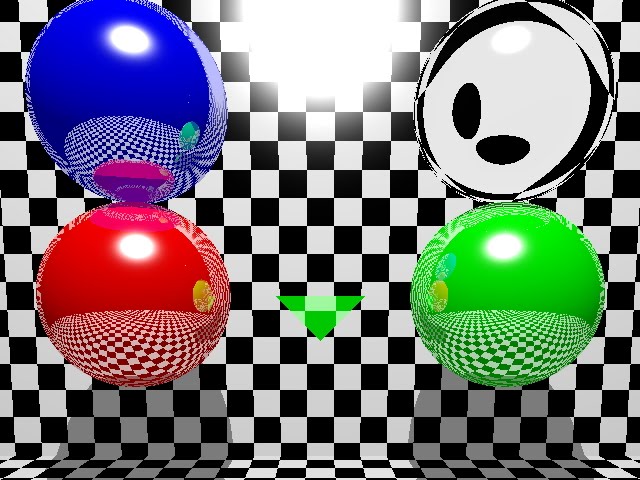
So what's next? I reckon:
* Distributed ray tracing
* Anti-aliasing
* More light types and lighting model types
That should be a good set of features to work on whilst I get my Haskell back up to speed. Once I'm back up to speed, I can start to look at meatier tasks like an asset pipeline or spatial partitioning.
I did have it running in parallel last time round, but that's all changed in Haskell in the last year or so, so I'll have to revisit that.
Sparse Voxel Octrees meet Marching Cubes
Some speculation here. I've not tried this idea out yet.
I've been doing a little reading up on Sparse Voxel Octrees lately, and an idea in Samuli Laine's papers particularly interested me. In these papers, "contours" are used to add shape to the basic octree voxels to enhance detail without extra subdivision.
I quite like this idea. I've been thinking of ways to try to extend the contour idea.
How about using a marching-cubes type algorithm to provide some more detailed geometry at the node or leaf level, based on the existence of non-existence of neighbouring octree cells?
You could quickly construct a bit mask based on the existence of neighbouring cells, use that to look up in a table providing several specific pieces of geometry for each case. This could add some extra detail and shape to each octree voxel.
I've been doing a little reading up on Sparse Voxel Octrees lately, and an idea in Samuli Laine's papers particularly interested me. In these papers, "contours" are used to add shape to the basic octree voxels to enhance detail without extra subdivision.
I quite like this idea. I've been thinking of ways to try to extend the contour idea.
How about using a marching-cubes type algorithm to provide some more detailed geometry at the node or leaf level, based on the existence of non-existence of neighbouring octree cells?
You could quickly construct a bit mask based on the existence of neighbouring cells, use that to look up in a table providing several specific pieces of geometry for each case. This could add some extra detail and shape to each octree voxel.
Subscribe to:
Posts (Atom)